

Oxford University project aims to recover an ancient library
An Oxford University project has received a gift to support its aim to use technology to retrieve text from ancient, unopened papyrus scrolls.
Last updated:

The collaboration between Oxford’s Faculty of Classics and the Vesuvius Challenge has received funding from the Humanities and AI Virtual Institute of Schmidt Sciences for a two-year project.
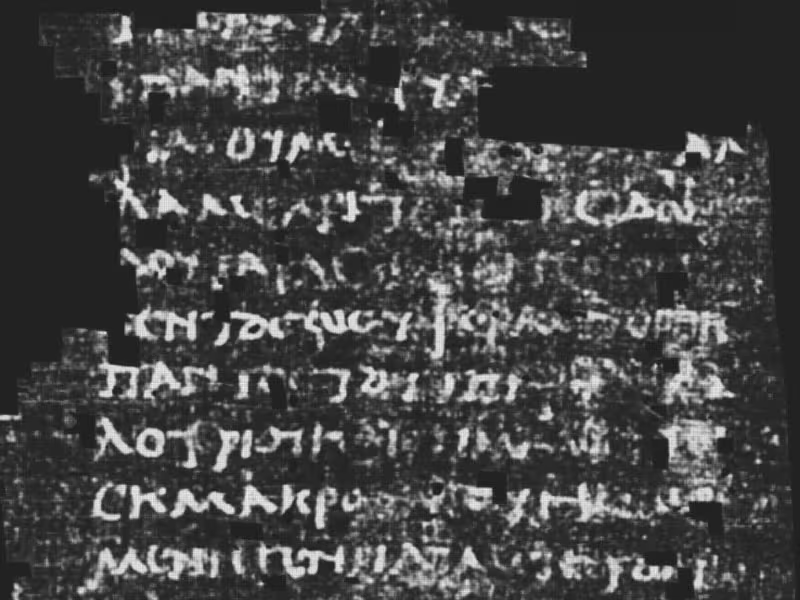
The scrolls – ancient ‘books’ – were carbonised (preserved, but in a very brittle condition) during the eruption of Mount Vesuvius in 79 CE and were discovered in the eighteenth century in a library within the so-called Villa dei Papiri at Herculaneum, an opulently furnished elite residence on the Bay of Naples.
Efforts to unroll these scrolls and recover the text within them have been ongoing since their discovery, with varying degrees of success. Texts partially recovered so far include works by the hugely influential ancient philosopher Epicurus, along with other Epicurean philosophers, notably Philodemus of Gadara, whose library it may all represent.
Subjects of the texts include the history of Greek philosophical schools (Plato's Academy, the Stoa), musical theory, debates about rhetorical theory, literary criticism and logic. Hundreds more scrolls remain unopened, and this new technology promises a ‘virtual unrolling’ that will leave the fragile scrolls intact but reveal their contents with vastly greater ease and precision than has ever been achieved before.
‘The prospect of a large part of an ancient library coming available to us, comprising texts hitherto unknown, could not be more exciting,’ said project leader Tobias Reinhardt, Corpus Christi Professor of Latin in the Faculty of Classics.
‘Now that the Vesuvius Challenge is using CT scanning on substantial numbers of unopened scrolls, there is an urgent need to automate parts of the text extraction pipeline so as to increase speed and reduce costs. A new generation of scholars is called upon to help: trained in papyrology to the highest standard but working closely with the Vesuvius Challenge on the optimisation of machine learning processes, they will contribute to editing and explaining the emerging texts.’
Two master’s students, to be recruited in the upcoming admissions round, will initially be trained in Herculaneum papyrology as part of the Master of Studies in Greek and/or Roman Languages and Literature, a nine-month taught course offering advanced study in classical texts, languages and scholarship methods.
“Oxford is a world-renowned centre for the study of papyrology, a discipline grounded in the traditional, technical skills of linguistic expertise and palaeography. But papyrologists have always exploited cutting-edge scientific developments to enhance their reading of these challenging texts. New breakthroughs in machine learning promise the most significant technological advance yet, and papyrology is among a growing number of AI-related projects involving members of the faculty.”
Herculaneum papyrology at Oxford has, in recent years, also been advanced by the Bodleian Library in collaboration with Diamond Light Source – the UK’s national synchrotron – at Harwell and the Faculty of Classics.
Schmidt Sciences already supports major fellowship schemes in other parts of the University, including the Eric and Wendy Schmidt AI in Science Postdoctoral Fellowship.